Transactivist Conversion Rhetoric


A post on transactivist homophobia is really the natural follow-up to a previous post I made, “Transition is Conversion Therapy.” If you haven’t already read it, I highly encourage you to - it covers state-sanctioned transition as a form of conversion therapy against gays and lesbians, all the way to the modern transition of gay kids.
This post will look into the various ways which transactivists promote homophobia and compulsory heterosexuality. It will build off of some things I wrote in the previous post, but I will link to those sections wherever I need to.
First, I need to provide some context for transactivist homophobia. Transgender ideology provides room for two seemingly opposing notions: the first, that humans can change sex, and the second, that biological sex does not exist at all. Whichever one you hear really just depends on which transactivist you’re talking to. The ideology holds room for these ideas because they’re both homophobic.
Promoting the false notion that humans can change sex is an attempt to redefine homosexuality to be inclusive of heterosexuality. It legitimizes straight people attempting to date gays of the opposite sex, regardless of whether or not the straight person in question is “truly transgender.”
For example, a transwoman - a man who identifies as a woman - attempting to date lesbian women. The fact that he calls himself a woman does not matter; he is still a man, and as such, no lesbian can ever be attracted to him.
Promoting the false notion that biological sex does not exist is an attempt to outright erase same-sex attraction by replacing it with “same-gender attraction.” This is where ideas such as “pansexual” - defined as “attraction to all genders” - come from. This notion assumes that sexual orientation is based on the arbitrary performance of gender roles and stereotypes.
Both notions are an attempt to further compulsory heterosexuality. This is pressure put onto gays and lesbians by society at large - their parents, peers, the media they consume, the people in power, etc. - to date the opposite sex. This pressure may be brazen, or it may be subtle.
Now that that’s out of the way, let’s start with one of the most well-known homophobic campaigns carried out by transactivists.
The Cotton Ceiling
In March 2012, Planned Parenthood Toronto announced a workshop titled “Overcoming the Cotton Ceiling: Breaking Down Sexual Barriers for Queer Trans Women,” which is a bit of a mouthful but sort of gets the idea across. The workshop was about exploring “the sexual barriers queer trans women face within the broader queer women’s communities” in regards to dating and having sex with lesbians.
This workshop popularized the term “cotton ceiling,” which transactivists directly appropriated from the glass ceiling - a barrier which women must break through to progress in the workplace. If you haven’t already guessed what the cotton referenced in the appropriation is, it’s a reference to lesbian women’s underwear. Transwomen view this as a barrier which they must break through to access sex.
As I stated above, lesbians’ refusal to have relationships with transwomen is due to the latter being men. Lesbians are, by definition, not attracted to men, no matter what they call themselves or how they present. From the transwoman’s perspective, a lesbian’s lack of interest in him is a form of bigotry, partially because this does not affirm him as the woman he believes himself to be, and partially because he feels entitled to women’s bodies.
An equivalent term used against gay men was also coined, this one somehow less subtle in its messaging: the “boxer ceiling.” This idea is weaponized by “gay transmen” - that is, straight women who identify as gay men. Like transwomen with lesbians, transmen know that rejection from gay men invalidates their perception of themselves as the opposite sex.
Transactivists do not seem to outright use these “ceiling” terms as openly as they once did. This is most likely because the meaning of these terms have escaped the communities which they came about in, and received heavy coverage from radical feminists and gay liberationists. However, the ideas behind these terms persist.
The “Genital Preference”
For the past several years, transactivists have used two similar terms to shame gay people: “genital preference” and “genital fetishist.” Both terms reduce sexual orientation to an attraction to someone’s genitals rather than an attraction to a person of a specific sex. The phrasing harks back to religious homophobia.
Calling one’s sexual orientation a “genital preference” attempts to frame homosexuality as a choice made by someone who could technically be attracted to the opposite sex. Accusing someone of “genital fetishism” implies that their sexual orientation is nothing more than a fetish. That’s not even mentioning the blatant oxymoron: a fetish, by definition, does not involve genitals.
In addition, framing sexual orientation as a “genital preference” is how transactivists give away that they only view homosexual relationships in terms of sex. Whether they realize it or not, they don’t believe that gays and lesbians are capable of having loving, romantic relationships with each other.
They also attempt to frame “genital preferences” as a manifestation of transphobia, and admonish gay people for having sexual and romantic boundaries. The idea behind this, of course, is to break down those boundaries and pressure gay people into dating the opposite sex. Straight trans people believe that they are owed sex from gay people, and that rejection is a personal attack.
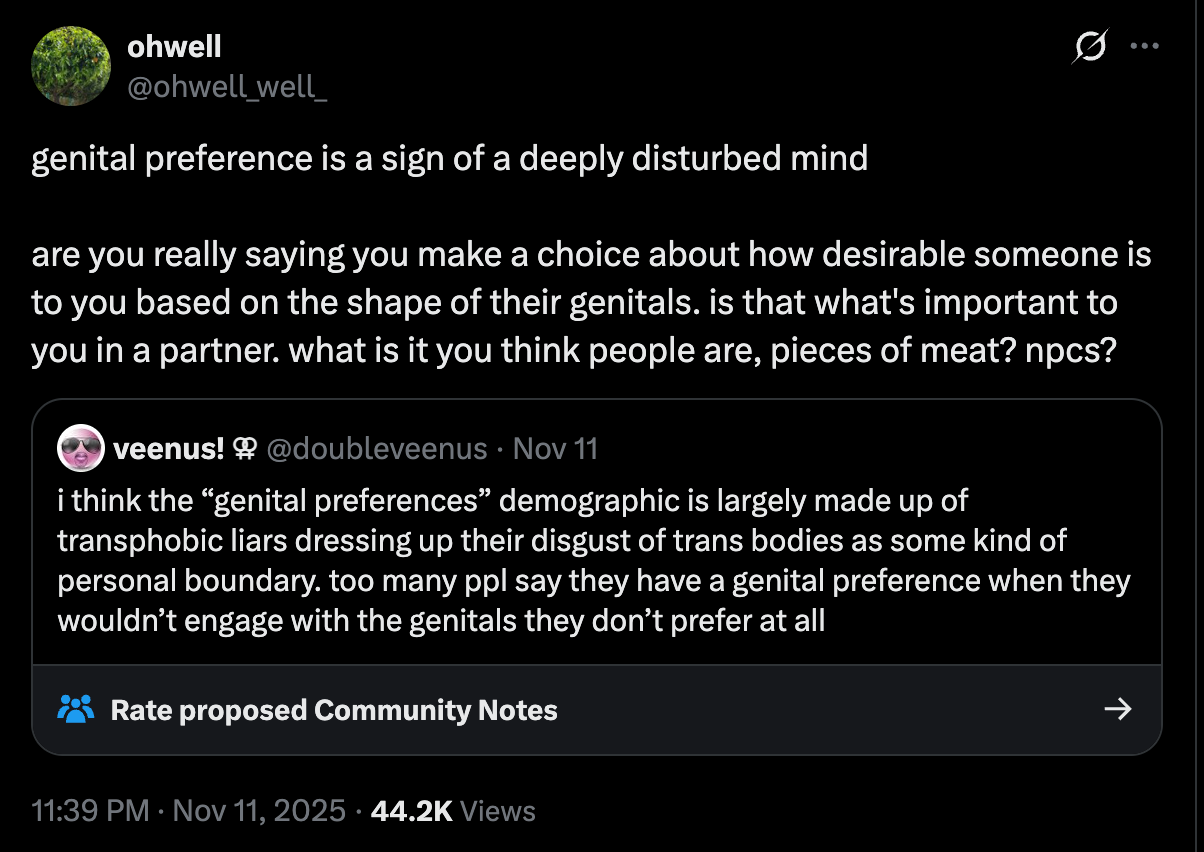

So, they tell gay people to “examine their genital preference,” a brazen attempt to shame them into dating trans-identifying members of the opposite sex. This accusation of “genital fetishism” is supposed to make gay people feel as though they are sexual deviants, the exact thing they were accused of being in decades prior.
In theory, terms such as these could also be used to shame straight women for not wanting to date transmen, or straight men for not wanting to date transwomen, but they rarely - if ever - are. They are almost solely weaponized against gays and lesbians, and that says a lot about the ideology of the people using them. Heterosexuals’ boundaries are respected; homosexuals’ boundaries exist to be broken.
Speaking of which.
Breaking Sexual Boundaries
Most people in relationships will want to have sex at one point or another, and naturally, this includes gays and lesbians. Obviously, someone who is gay would be extremely uncomfortable with going down on someone of the opposite sex. This is where transactivists suggest sexual acts which don’t involve the transgender person’s genitals. As if that’s supposed to, for example, make a gay man cool with receiving oral sex from a woman.
A lot of straight trans people desire sex with gays and lesbians so much that they’ll refuse to disclose their identity or birth sex to the person they’re pursuing. This often manifests as catfishing on dating apps by using heavily edited photos; however, it also gets into the realm of sex. They sometimes engage in oral so as not to reveal their biological sex; in a dark room, or in a case where the trans person “passes” well enough, it may be more difficult for the victim to tell that the other person is the opposite sex.
Failing to disclose information which could lead to someone refusing sex or revoking consent is rape by deception. If a lesbian woman has been deceived into believing that a man giving her oral sex is a woman, the man is committing rape. This is directly forcing gay people into straight sex which they did not consent to, and would not have consented to if they’d known of the other person’s biological sex.
Other tactics are more direct about the trans person’s desire for penetrative sex. This is most often forced upon lesbians by transwomen, who compare their penises to strap-ons. This is based on the assumption that lesbian women most commonly use these when having sex with each other. Since transwomen tend to believe that penetrative sex is the default, they reckon that a man’s penis is no different, and just an “organic” strap.
Another common talking point that they use against lesbian women is that she “just hasn’t tried girldick yet.” This is no different from the average homophobic man saying that she “just hasn’t had the right guy yet.” Transmen do this to a lesser extent - again, by assuming that penetrative sex is the default between gay men. Gay men stick it in each other all the time, she believes, therefore, my vagina is not all that different.
It’s not all that different with a trans person who has had full sex-reassignment surgery. SRS is misleadingly named because obviously, cosmetic surgeries can’t change your sex; inverting your penis does not somehow make it a vagina, and it definitely doesn’t make it anything appealing to lesbian women. Vice versa for a tube of arm or leg skin attached to your crotch.
If They Don’t Repent
When a gay person remains adamant in not being attracted to the opposite sex, their sexual orientation is reduced to fear of genitals. They’re told that sex with people they are incapable of being attracted to is actually fun and pleasurable, and that they’re missing out on a lot.
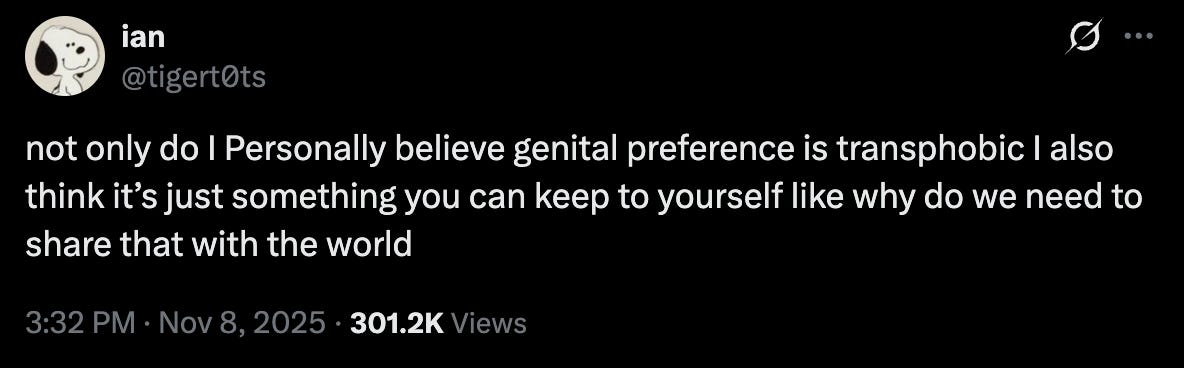
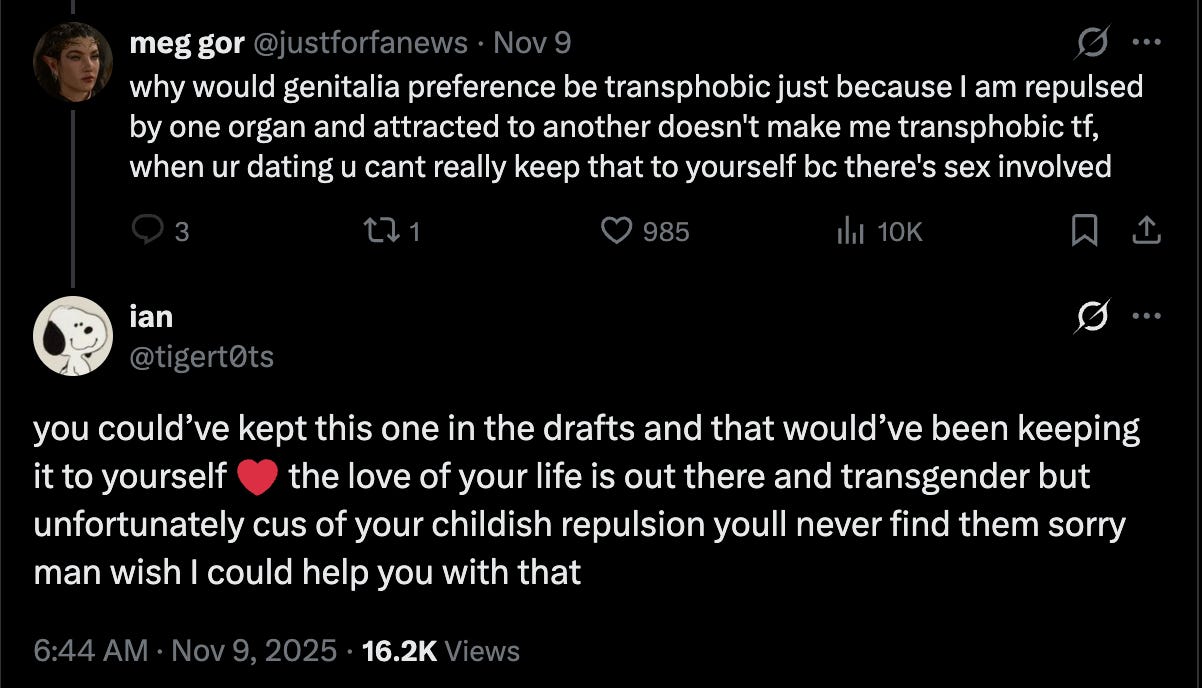
Transactivists gaslight gay people by telling them that nobody is saying they have to have sex with people they’re not attracted to. Barring the fact that this is a lie (as the receipts at the end of this post prove), there’s still so much subtle pressure to date people they aren’t into, such as the post I linked above.
In the event that a gay person does not succumb to pressure, transactivists just outright tell them to keep their sexual orientation to themselves. Sound familiar?
LGB Appropriation & Misrepresentation
Transactivists frame themselves as attracted to people, and gays and lesbians as attracted to parts. They say that “real gays” care about the person they date instead of the genitals attached.
This “people vs. parts” framing is used by “pansexual” activists with the slogan “hearts, not parts.” (This slogan is derived from “fix your hearts, not our parts,” used by intersex activists.) “Pansexual” is used to describe people who are attracted to “all genders”; however, sexual orientation is based on biological sex, of which there are two, and not gender, which is a social construct.
Regardless, “pansexual” activists use this slogan to state that they’re attracted to all people, regardless of parts, unlike homosexuals and heterosexuals, who they purport to be attracted to genitals. Some bisexuals use this slogan as well due to their capability to be attracted to both sexes, but it’s much more strongly associated with “pansexuality.” It’s just a form of moralizing and playing holier-than-thou, usually against gay people.
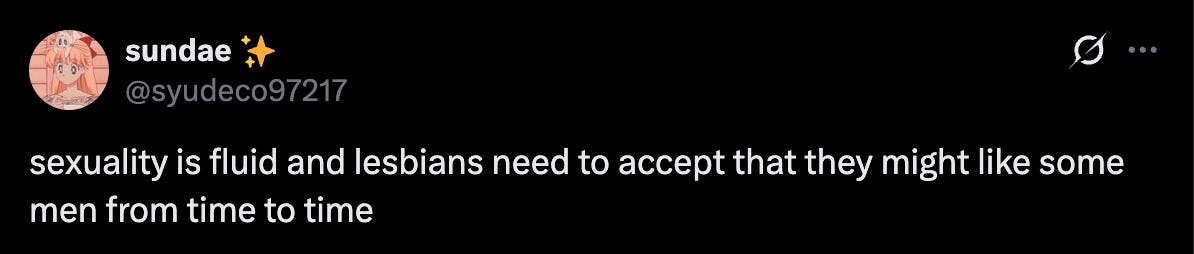
Many transactivists also attempt to use bisexuality as a cudgel against gay women and men by saying that everyone is “a little bi”, or outright claim that sexuality is fluid. I covered the second talking point in my previous post, and how it’s being used by organizations that push conversion therapy. These ideas come from the same place - “Fine, you can be attracted to the same sex, but look at these people of the opposite sex! You should experiment and date them!”
Even gay transgender people engage in this rhetoric. Juno Dawson, a gay male author who identifies as a straight women, said in an interview with the magazine Attitude that he believes many gay men “misdiagnosed” themselves as gay, and that they were actually just transwomen. To quote him directly: “I think there are a lot of gay men out there who are gay men as a consolation prize because they couldn’t be women.”
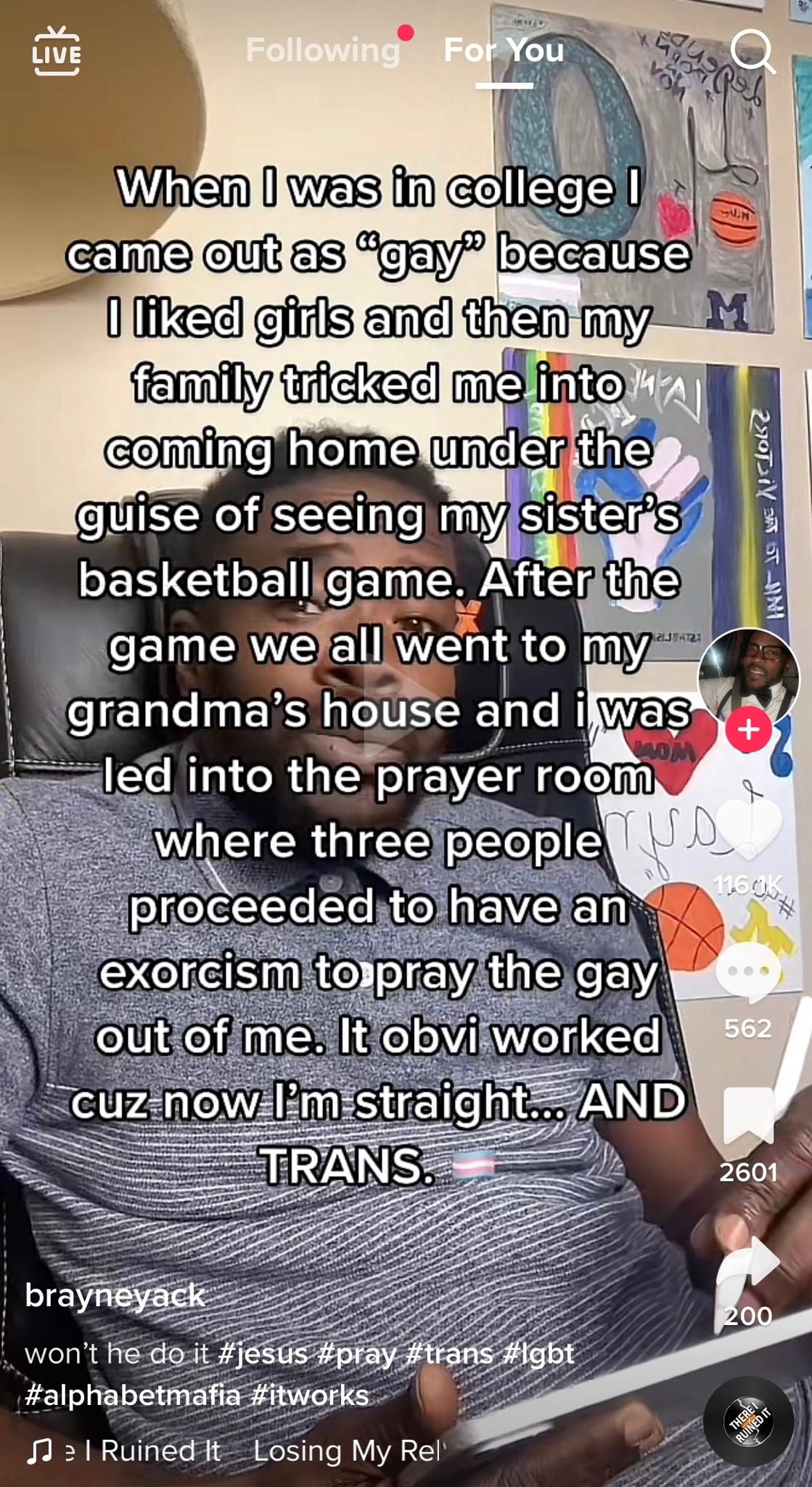
Layne Ingram, a lesbian woman who identifies as a straight man, made a video about how her family held a “pray away the gay” session for her when she was in college. She “joked” that it must have worked, because she came out as trans. In her eyes, and her family’s eyes, she’s now a straight man, and therefore, her attraction to women isn’t scrutinized in the same way.
Effects of Causes
The effects of all of this are far-reaching. A book titled “Girl Sex 101” has a whole section on penile anatomy, not-so-subtly hinting that lesbians should be open to having sex with men. Lesbian women are gaslit into thinking that their innate sexual orientation is bigoted, and when they ask for advice, they’re only gaslit further. Transactivist homophobia is designed to break down a gay person’s barriers in order to force them into romantic and/or sexual relationships with people they have no attraction to. This is rape culture.
There are much more serious consequences, too. Gay people, the majority of them lesbian women, are subtly pressured into romantic and/or sexual relationships with trans people of the opposite sex. This is compulsory heterosexuality disguised as a “cis for trans” gay relationship.
With lesbian women, the intersection of their female sex and their same-sex attraction means they’re much more vulnerable to harassment and corrective rape from the average homophobic man. However, when a transwoman commits one of these, the lesbian woman is gaslit by other people who call her assailant a woman.
When a transwoman does harass or rape a lesbian, he can fall back on “queer” or “LGBT” social groups to further control and intimidate his victim. The reality of his crime as one rooted in homophobia and misogyny is erased, and the victim must walk on eggshells when talking about the situation. If she correctly names the perpetrator as male, or names the crime as homophobic and misogynistic, she faces intense backlash from the social groups.
And sometimes, the perpetrator smears his victim preemptively. He calls her a “TERF” or “transphobe” to other members of the social group, even if she’s completely supportive of trans politics. This results in her ostracization without her even saying anything, and gets people to disregard her if she talks about what the perpetrator did to her. In their minds, she’s a transphobe who must be making up rape allegations in order to ruin an innocent transwoman’s life.
Transwomen hitting on lesbians in gay bars, sexual assault in supposed safe spaces, fears of running into their assailant - these all lead the victims to self-exclude from third places and support groups. This is insidious considering these spaces were meant for gay people to begin with.
So, to recap: transgender ideology, inherently homophobic as it is, gives transactivists the green light to shame gay people for being gay. They tell gay people that if they wouldn’t date a trans person of the opposite sex, they’re bigoted. They tell gay people that their sexual orientation is disgusting and immoral.
This kind of rhetoric means that when a transwoman sexually harasses or rapes a lesbian, the reality of it being a homophobic and misogynistic hate crime is erased. If the victim accurately calls the perpetrator male, she is hounded out of her community, while the perpetrator is free to continue to victimize other women.
And all of this is dressed in the veneer of progressivism.
While I’ve shared some examples of transactivist homophobia, this isn’t meant to be a receipts post, because other people have done a phenomenal job of documenting their behavior. If you want to see more examples of this spanning back years, check out the following links:
terfisaslur.com - cotton ceiling and autogynephilia
15-part reblog chain documenting transactivist homophobia
Transactivists react to Supreme Court enshrining marriage equality
74-part post, not the same as the one above
terfstillmeanslesbian Tumblr blog
Homosexuality is not hate. Drop the fucking T.